AI Chatbot vs Live Chat vs Help Desk for Shopify Stores
Comparing AI chatbots, live chat and help desks for Shopify: what each does best, where each falls short, and how to combine them as your store grows.
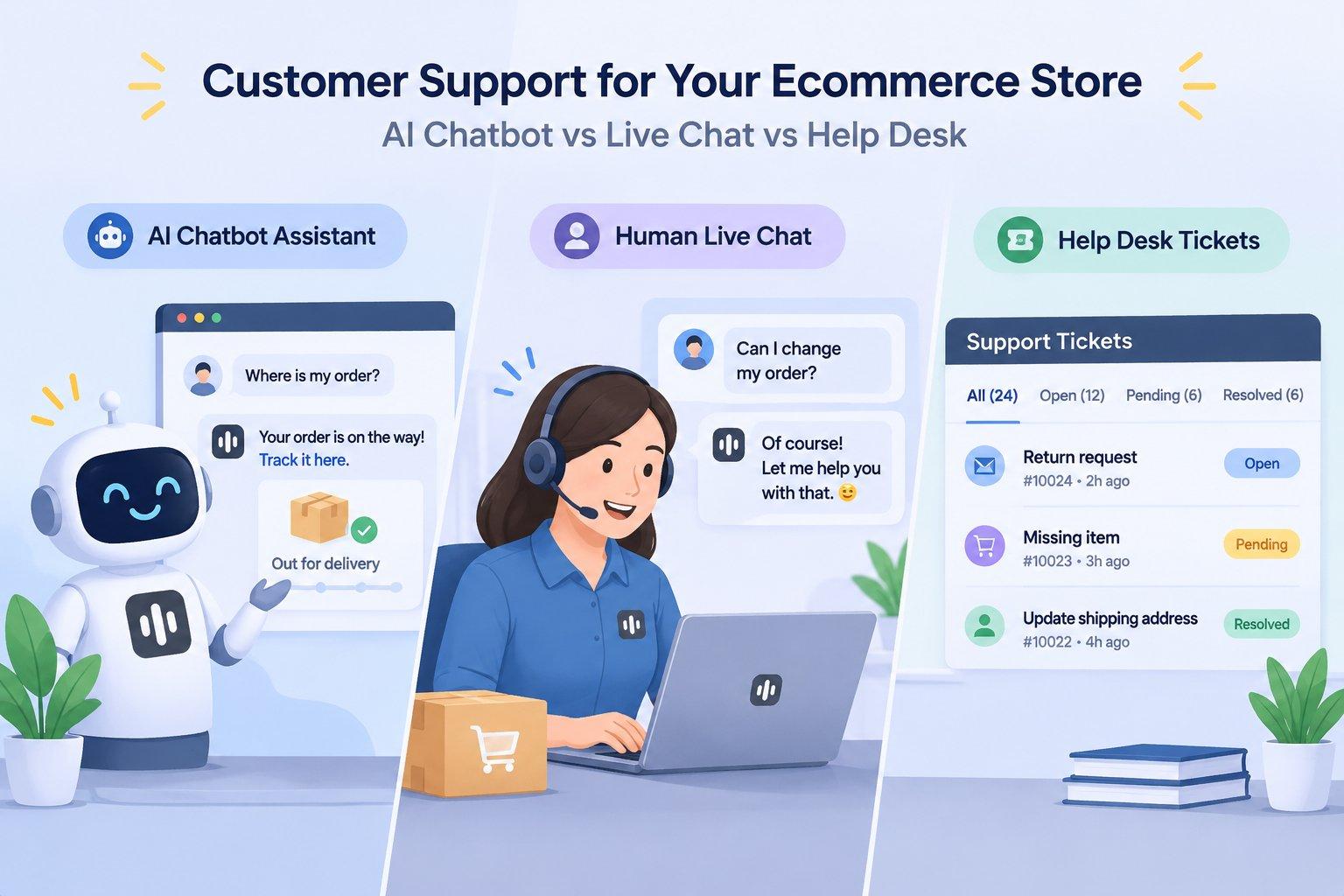
AI Chatbot vs Live Chat vs Help Desk: What Does Your Shopify Store Actually Need?
Short answer: an AI chatbot answers common questions instantly, around the clock; live chat puts a human in real-time conversation with shoppers; a help desk organizes requests into tickets so nothing gets lost. Small stores usually get the most value from an AI chatbot backed by a shared inbox where humans step in. As volume grows, you'll want all three working together rather than choosing one.
Let's break down what each tool does, where it shines, and how to decide.
The three tools at a glance
| AI chatbot | Live chat | Help desk | |
|---|---|---|---|
| Who replies | AI, from your store data | A person, in real time | A person, asynchronously |
| Availability | 24/7 | When staff are online | Business hours, queued |
| Best for | Repetitive questions, order lookups, after-hours | Pre-sale conversations, complex or emotional issues | Multi-step cases: returns, damaged items, disputes |
| Main risk | Wrong or robotic answers if poorly set up | Slow or missed replies when nobody's online | Customers wait; feels formal for quick questions |
| Scales with volume? | Yes | Only by hiring | Yes, with clear workflows |
AI chatbots: speed and coverage
An AI chatbot answers from your catalog, policies and order data. Modern bots understand natural language, so customers can type "my parcel hasn't moved in days" rather than clicking through rigid menus.
Where it shines
- Instant replies to the questions you get every day: shipping times, return windows, sizing.
- Order status lookups without a human opening the Shopify admin.
- Coverage at night, on weekends and during sales spikes.
- Consistent answers: every customer hears the same policy.
Where it falls short
- Emotional situations. An angry customer needs empathy and judgment.
- Exceptions to policy. Bots should follow rules, not bend them.
- Anything it hasn't been taught. A poorly trained bot can frustrate more than it helps.
The key question: can it hand off cleanly to a human, with context? A bot without a good escape hatch is a dead end.
Live chat: the human touch, in real time
Live chat is a person typing back to a shopper on your site or social channels, right now.
Where it shines
- High-consideration purchases where shoppers want reassurance.
- Complicated questions that need back-and-forth.
- Recovering upset customers before they leave a bad review.
Where it falls short
- It only works when someone is online. Many shoppers browse in the evening, when small teams are offline.
- It doesn't scale cheaply: more chats means more people.
- Agents spend a lot of time on the same simple questions, which is a waste of their skills.
Help desks: structure for the messy cases
A help desk turns requests into tickets with status, owner, priority and history.
Where it shines
- Multi-step issues: a return that needs a label, inspection and refund.
- Making sure nothing slips through when several people share support.
- Reporting on response times and recurring problems.
Where it falls short
- It can feel slow for quick pre-sale questions. Nobody wants a ticket number for "do you ship to Canada?"
- Separate help desks often sit apart from social DMs and chat, so context gets split across tools.
Which do you need? A practical decision guide
You're a solo founder or a team of one or two. Start with an AI chatbot connected to your store and a single shared inbox where you can take over conversations. Your biggest problem is coverage, not organization.
You have a small support team and growing volume. Keep the AI on the front line for common questions, have humans handle live conversations that need judgment, and use ticket-style tracking for returns and problem orders.
You're scaling fast or selling across many channels. You need all three, ideally in one place. The more tools you stitch together, the more often a customer has to repeat themselves.
Questions to ask before you buy
- Does it cover all my channels? Store chat, Instagram, Messenger, WhatsApp and email, or just one?
- Does the AI answer from my data? Generic answers aren't good enough.
- How does handoff work? Does the human see a summary, or start from zero?
- What can the AI actually do? Look up orders? Create draft orders? Or just answer FAQs?
- How much control do I keep? Can I require approval for sensitive actions?
- Can I see results? Is there reporting on conversations and revenue influenced?
The real answer: combine them
The best support setups don't treat these as competing options. A typical flow:
- AI answers first, instantly, for the most common questions.
- When a human is needed, the conversation moves to a person in the same inbox, with a summary.
- Cases that take several steps are tracked so they get closed out properly.
Customers get speed when they need speed and a human when they need a human. Your team stops answering the same question repeatedly and focuses on conversations that matter.
How TaggoAI helps
TaggoAI for Shopify brings the AI chatbot and the human side together:
- AI chatbot, 24/7: product advice, order tracking and draft order creation across your store chat, Messenger, Instagram, WhatsApp and email.
- Shared inbox: every channel in one place, so your team can pick up any conversation. When the AI isn't sure, it hands off with a conversation summary.
- CRM and segmentation: customer profiles and history in one view.
- Revenue reporting: see the revenue Taggo helped bring in.
- You stay in control: choose the AI's autonomy level, from suggestions only to answering common questions on its own while important actions wait for approval.
You can install Taggo: AI Chatbot from the Shopify App Store and try it for 14 days.
FAQ
Is an AI chatbot a replacement for live chat? Not entirely. It handles repetitive questions and after-hours coverage, freeing people for conversations that need judgment. Most stores benefit from both.
Do small Shopify stores need a help desk? Not always as a separate tool. A shared inbox with assignment and internal notes often covers what a small team needs.
Will customers be annoyed by talking to AI? Customers mostly want fast, accurate answers. Frustration usually comes from bots that can't help and won't hand off. A clear path to a human solves most of that.
Can I use AI only after hours? Many tools let you adjust how and when the AI replies. It's a sensible way to start.
Conclusion
AI chatbots give you speed and coverage, live chat gives you a human touch, and help desks give you structure. For most Shopify stores, the winning setup is AI on the front line with humans ready in the same inbox. Start with your biggest gap, usually after-hours coverage, and build from there.
Want to see it on your store? Start a 14-day trial of Taggo: AI Chatbot from the Shopify App Store.
Ready to elevate your customer experience?
Deploy intelligent AI agents for your business in minutes.

