Live Chat vs Email vs Social DMs for Shopify Stores
Compare live chat, email, and social DMs (Instagram, Messenger, WhatsApp) for Shopify customer support: strengths, trade-offs, and how to run them together.
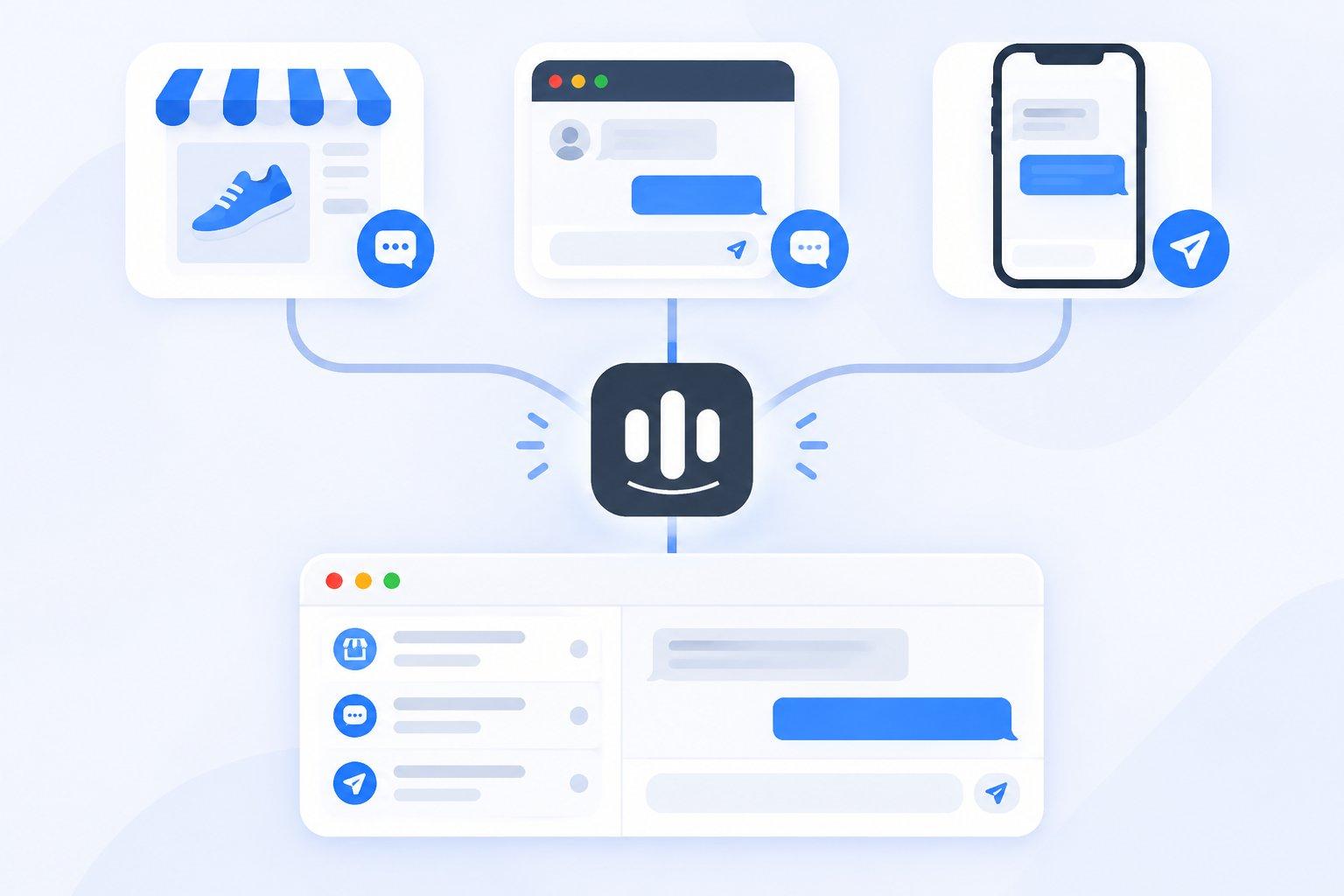
Live Chat vs Email vs Social DMs: Which Support Channels Should Your Shopify Store Offer?
Short answer: most Shopify stores benefit from offering live chat on the store for pre-purchase questions, email for order issues that need records and attachments, and social DMs (Instagram, Messenger, WhatsApp) wherever their customers already discover the brand. The real question isn't which single channel to pick, but how many you can answer well. If you can't respond quickly on a channel, it may be better not to advertise it, or to bring all channels into one inbox and add automation so every message gets a reply.
The three channel types at a glance
| Live chat (on store) | Social DMs | ||
|---|---|---|---|
| Best for | Pre-purchase questions, quick help | Order issues, returns, documentation | Discovery, product questions, community |
| Customer expectation | Reply in minutes | Reply within hours to a day | Fast, conversational |
| Context available | Page the shopper is on | Order details, attachments | Post or ad they came from |
| Main risk | Unanswered chats at night | Slow back-and-forth | Messages scattered across phones and apps |
Expectations vary by audience and industry, so treat the table as a starting point, not a rule.
Live chat on your Shopify store
Strengths
- Catches shoppers at the moment of decision. Someone asking about sizing on a product page is close to buying.
- Context-rich. You (or your assistant) know which product they're looking at.
- Short conversations. Many questions can be resolved in two or three messages.
Trade-offs
- High expectations for speed. A chat window that sits unanswered can feel worse than having no chat at all.
- Hard to staff around the clock. Small teams struggle to cover evenings and weekends, which is often when shoppers browse.
Choose it if: you get meaningful traffic on product pages and want to convert more of it.
Email support
Strengths
- Asynchronous and documented. Good for returns, damaged items, billing questions, or anything that needs photos and a paper trail.
- Easy to start. Every store already has an email address.
- Calmer for the team. Less pressure for instant replies.
Trade-offs
- Slow for simple questions. A shopper who wants to know if a jacket runs small won't wait a day.
- Threads get long. Back-and-forth over email can stretch a simple issue across several days.
Choose it if: you need a reliable channel for post-purchase issues and records. Almost every store should keep it.
Social DMs: Instagram, Messenger, WhatsApp
Strengths
- Meets customers where they discover you. If your brand grows through Instagram content or ads, shoppers will message there first.
- Personal and conversational. Great for product questions, styling advice, and building loyalty.
- WhatsApp is popular in many international markets and convenient for order updates and follow-ups.
Trade-offs
- Easy to lose track. DMs often live on one person's phone, separate from the rest of support.
- Mixed message types. Customer questions arrive alongside comments, collaboration requests, and spam.
- Hard to measure. Without one inbox, it's difficult to know how many DMs went unanswered.
Choose it if: social media is a real source of traffic and sales for you, not just a channel you "should" be on.
How to decide: a simple checklist
- Where do your customers already message you? Look at the last month. Don't open new channels nobody uses.
- Can you answer each channel within its expected time? If not, fix coverage before adding more.
- Where are you losing the most sales? Often it's unanswered pre-purchase questions on store chat and DMs.
- Can your team see everything in one place? If channels live in separate apps, response times and consistency suffer.
- What can be automated safely? Order status, shipping times and common product questions are usually good candidates.
The case for "fewer gaps, not fewer channels"
Many small stores cut channels because they can't keep up. That's reasonable, but it can mean losing shoppers who prefer those channels. A better long-term approach is usually:
- Bring every channel into one unified inbox so your team works from a single queue.
- Use one source of truth (policies, shipping times, product details) so answers are consistent everywhere.
- Add an AI assistant to reply instantly on every channel and pass complex conversations to a person.
That way you can stay present where customers are without multiplying your workload.
How TaggoAI helps
TaggoAI for Shopify is designed for exactly this multi-channel setup:
- One AI assistant across channels: your store chat, Messenger, Instagram, WhatsApp and email.
- TaggoAI Inbox: a unified inbox where messages from every channel land in one place, with assignment, internal notes, and a mini CRM that keeps customer profiles, tags and purchase history.
- Answers from your own data, so a shopper gets the same answer on Instagram as on your store chat.
- Practical tasks: order lookup, delivery tracking, product recommendations and abandoned cart recovery.
- Handoff with a summary when a human needs to step in.
You decide how independent the assistant is, from drafting replies for approval to answering common questions on its own.
FAQ
Should a small Shopify store offer live chat if no one can answer at night? Only if something covers those hours, such as an AI assistant that answers common questions and collects details for your team. An unanswered chat window can hurt trust.
Is email support still necessary if I have chat? Usually yes. Email remains the most practical channel for returns, damaged items and anything that needs attachments or a written record.
Which social channel matters most for support? The one your customers already use. Check where your DMs come from today before investing in a new channel.
Can one tool handle all these channels? Yes. A unified inbox brings store chat, social DMs and email into one queue so your team and an AI assistant can work from the same place.
Conclusion
Live chat wins pre-purchase moments, email handles the paperwork, and social DMs meet customers where they discover you. Instead of choosing just one, choose the channels your customers actually use, then make sure every message lands in one place and gets a timely reply.
Want every channel answered without adding headcount? Try TaggoAI for Shopify and run store chat, social DMs and email from one inbox with an AI assistant on duty 24/7.
Sẵn sàng nâng tầm chăm sóc khách hàng?
Tạo AI Agent thông minh cho doanh nghiệp của bạn chỉ trong vài phút.

