WhatsApp Business API vs WhatsApp Business App: What Shopify Merchants Need to Know
Explore the critical differences between the WhatsApp Business App and WhatsApp Business API for Shopify merchants. Learn when to upgrade, how to automate order tracking and cart recovery, and how TaggoAI supercharges your conversational commerce.
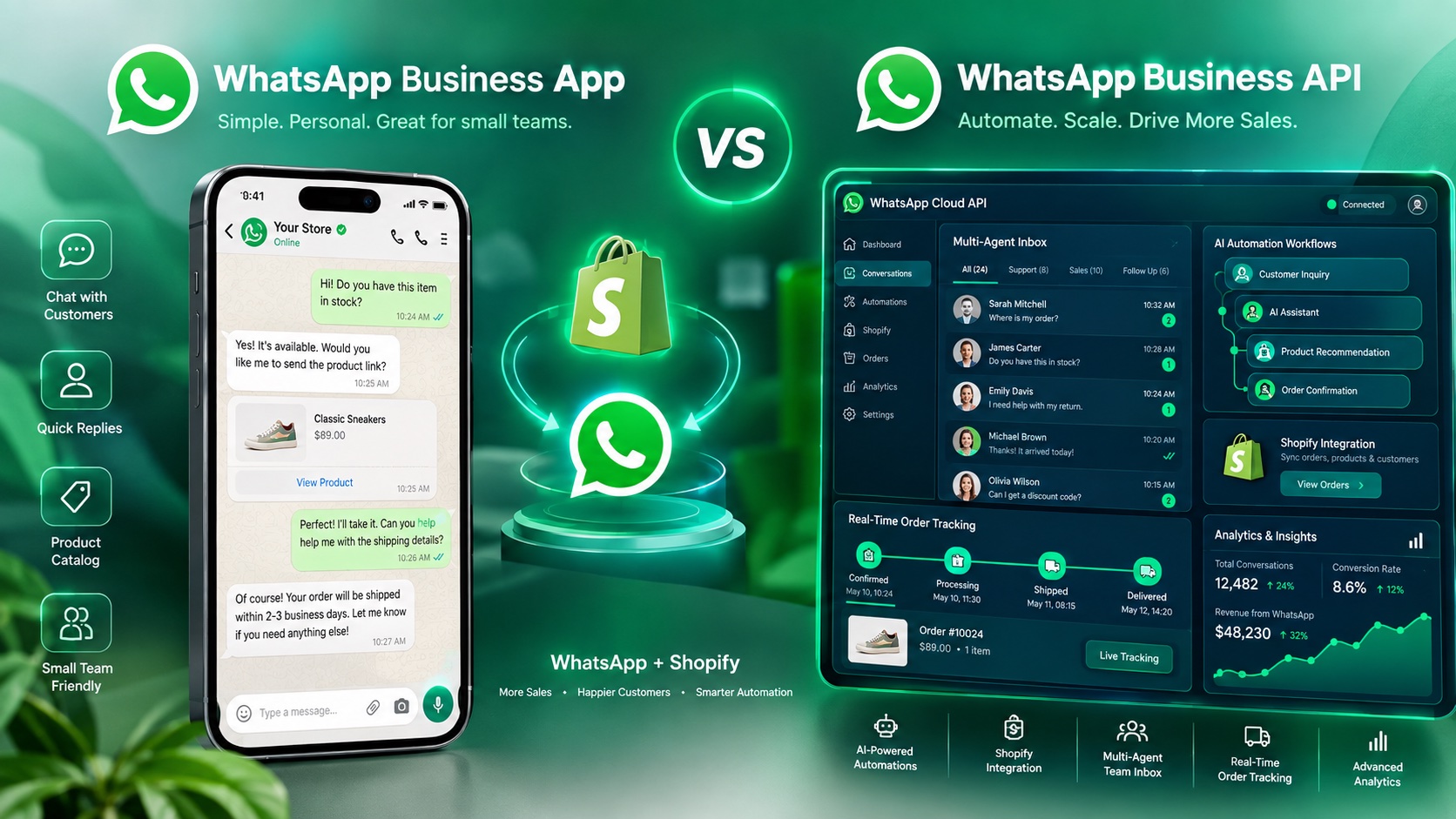
As ecommerce evolves in 2026, conversational commerce has shifted from an optional marketing experiment into an indispensable revenue driver for Shopify brands. With over 2.7 billion active monthly users, WhatsApp offers an unbeatable 98% open rate and click-through rates that dwarf traditional email and SMS marketing.
However, when Shopify merchants decide to leverage WhatsApp for customer communication, marketing, and support, they inevitably face a pivotal decision:
Should you stick with the free WhatsApp Business App, or invest in the WhatsApp Business API (Cloud API)?
Choosing the wrong option can lead to restricted messaging limits, missed sales opportunities, operational bottlenecks, or even risking account bans. In this comprehensive guide, we will break down the core differences, technical capabilities, pricing models, and practical considerations so you can choose the right solution for your Shopify business.
1. What is the WhatsApp Business App?
The WhatsApp Business App is a free mobile application designed primarily for solopreneurs, local boutique retailers, and small businesses handling low customer conversation volumes.
It can be downloaded directly from the Apple App Store or Google Play Store and functions much like the standard WhatsApp messaging app, with a few basic commercial features added on top.
Key Features of WhatsApp Business App
- Business Profile: Add your store logo, description, business hours, website link, and address.
- Product Catalog: Showcase up to 500 items directly inside the app for manual browsing.
- Basic Auto-Responses: Set simple greeting messages, away messages, and predefined quick replies.
- Labels & Tags: Color-coded labels to organize chats (e.g., "New Customer", "Pending Payment").
- Limited Multi-Device: Can be linked to up to 4 companion web/desktop devices and 1 primary smartphone.
- Broadcast Lists: Send promotional messages to a maximum of 256 contacts per list (provided recipients have saved your phone number).
Major Limitations for Scaling Shopify Stores
- No Direct Shopify Automation: You cannot trigger automated WhatsApp notifications when a customer places an order, abandons a checkout, or when a shipment status changes on Shopify.
- 256-Contact Broadcast Cap: Reaching large customer segments is impossible without tedious manual list management.
- High Ban Risk: Manually blasting promotional messages to customers who haven’t saved your phone number frequently triggers spam flags and permanent number bans by Meta.
- Team Collaboration Bottlenecks: When multiple support agents reply from linked devices, message collisions occur, and tracking agent accountability or performance metrics is impossible.
- Zero Autonomous AI Support: Unable to deploy autonomous AI agents capable of answering complex inquiries, checking real-time inventory, or handling returns 24/7.
2. What is the WhatsApp Business API (Cloud API)?
The WhatsApp Business API (also known as the WhatsApp Cloud API) was engineered by Meta specifically for growing direct-to-consumer (D2C) brands, mid-market businesses, and enterprise ecommerce operations.
Unlike the mobile app, the API has no standalone user interface. Instead, it connects your WhatsApp phone number directly to backend systems, CRM platforms, Shopify webhooks, and intelligent conversation platforms like TaggoAI.
Core Capabilities of WhatsApp Business API
- Deep Shopify Ecosystem Integration: Automatically trigger events via webhooks — order confirmations, shipping updates with live tracking links, abandoned cart recovery sequences, and review requests.
- Unlimited Multi-Agent Support: Connect your entire customer support and sales team to a unified inbox with role-based permissions, ticket assignment, and collision detection.
- Intelligent 24/7 AI Agents: Deploy AI agents (like TaggoAI) that understand natural language, query your Shopify store database for real-time order status, recommend personalized products, and resolve up to 85% of customer inquiries instantly.
- Mass Broadcast Campaigns: Send personalized, rich-media marketing messages to thousands of opted-in customers simultaneously without saving phone numbers in an address book.
- Official Green Tick Verification: Apply for Meta’s official verified green checkmark badge, boosting brand credibility and customer trust.
- Interactive Message Templates: Use clickable buttons, quick reply pills, product carousels, and list menus that make shopping inside WhatsApp frictionless.
- Rich Analytics & Compliance: Track message delivery rates, read rates, click-through rates, customer satisfaction scores, and full audit logs.
3. Side-by-Side Comparison: App vs API
To help you quickly identify which solution aligns with your current operations, here is a detailed feature-by-feature comparison:
| Feature WhatsApp Business App WhatsApp Business API | ||
| Target Audience | Solopreneurs & micro-stores (< 10 orders/day) | Growing & scaling Shopify brands (10 to 10,000+ orders/day) |
| Shopify Integration | None (Manual copy-paste) | Full real-time webhook & REST API sync |
| Automated Notifications | Basic greeting / away messages only | Order updates, abandoned carts, tracking, COD verification |
| AI Chatbot & Agents | No AI capability | Advanced LLM AI Agents (TaggoAI) for 24/7 autonomous support |
| User & Agent Seats | Max 5 devices (1 phone + 4 linked web) | Unlimited agents with Unified Multichannel Inbox |
| Broadcast / Marketing Limit | Max 256 contacts per list (Requires contact save) | Tiered: 1,000 to unlimited contacts daily |
| Green Tick Verification | Not available | Eligible for Official Meta Verified Green Checkmark |
| Cost & Pricing | 100% Free app | Per-conversation Meta fees + Platform subscription (TaggoAI) |
4. Key Decision Criteria: When Should Shopify Merchants Upgrade?
If you are wondering whether it’s time to move from the free app to the WhatsApp Business API, evaluate these five critical operational triggers:
1. Order Volume Exceeds 10–15 Orders per Day
When you handle only 2 or 3 orders daily, manually sending tracking numbers on your phone is manageable. But as daily orders grow to 20, 50, or 100+, manual messaging becomes an operational nightmare. The API automates order confirmation, delivery alerts, and returns without lifting a finger.
2. High Abandoned Cart Rate
Cart abandonment in ecommerce averages between 70% and 75%. Traditional recovery emails often end up in the spam or promo folder with sub-15% open rates. With the WhatsApp API, automated abandoned checkout reminders reach customers within minutes, delivering recovery rates as high as 25%–35%.
3. Customer Support Tickets are Overwhelming Your Team
Over 70% of ecommerce customer inquiries fall into repetitive categories: "Where is my order?" (WISMO), "What is your return policy?", "Which size fits me?", or "Is this item in stock?". Connecting the WhatsApp API to an AI agent like TaggoAI resolves these questions instantly in any language, 24/7.
4. You Want to Scale Multi-Agent Support
If you have two or more customer service reps, using a single smartphone or shared web tabs results in duplicated replies, dropped conversations, and zero visibility into response times. The API provides a true collaborative CRM workspace.
5. You Want to Run Proactive Promotional Campaigns
Planning Black Friday, seasonal sales, or VIP flash discounts? With the WhatsApp API, you can segment your Shopify buyers based on purchase history (e.g., customers who bought in the last 60 days) and send personalized broadcast campaigns with dynamic discount codes.
5. How to Supercharge WhatsApp API for Shopify with TaggoAI
Getting access to the WhatsApp Business API is only the first step. To unlock its full potential, Shopify merchants need an intelligent automation layer that connects Meta’s Cloud API with their storefront.
TaggoAI acts as the central AI operating system for your ecommerce store, delivering an end-to-end conversational commerce solution:
- Instant 1-Click Shopify Sync: Seamlessly integrate product catalogs, inventory levels, order fulfillment statuses, and discount rules.
- Autonomous 24/7 AI Agents: Unlike rigid rule-based bots with robotic decision trees, TaggoAI uses generative AI to understand nuanced shopper questions, handle context-aware upsells, and process complex return requests.
- Automated Revenue Sequences: Pre-built automated workflows for:
- Abandoned Cart Recovery with dynamic product preview cards
- Cash-on-Delivery (COD) Order Confirmation & anti-fraud verification
- Real-time Courier Shipping & Fulfillment updates
- Post-purchase satisfaction reviews and repeat purchase incentives
- Unified Multichannel Inbox: Manage customer conversations across WhatsApp, Facebook Messenger, Instagram DM, Live Chat, and TikTok in a single unified interface.
- Smooth Human Handoff: When high-value VIP inquiries or sensitive edge cases arise, the AI smoothly transfers the chat to your human agents with complete conversation history and context summaries.
6. Best Practices for Shopify WhatsApp Marketing
To maximize revenue while maintaining high customer satisfaction and Meta quality ratings, adhere to these proven best practices:
- Always Obtain Explicit Opt-In: Ensure shoppers opt in during checkout (e.g., a pre-checked or optional checkbox for WhatsApp updates) or via interactive website widgets.
- Personalize Every Message: Use dynamic parameters such as the customer’s first name, the exact products left in their cart, and localized currency.
- Respect the 24-Hour Customer Care Window: When a customer messages you, reply promptly within the 24-hour window to keep support conversation costs minimal.
- Offer an Easy Opt-Out: Always give customers a clear way to unsubscribe (e.g., "Reply STOP to unsubscribe") to preserve a high quality score on Meta.
Conclusion: Which One Should You Choose?
If you are just launching your first Shopify store with fewer than 5 orders a day and zero budget, the WhatsApp Business App is a great starting point to learn customer habits.
However, if you are looking to scale your store, automate repetitive support, recover lost checkouts, and provide a world-class customer experience, the WhatsApp Business API combined with TaggoAI is the definitive choice for modern ecommerce leaders.
Ready to elevate your customer experience?
Deploy intelligent AI agents for your business in minutes.