Product Quiz vs AI Shopping Assistant for Shopify
Product quiz or AI shopping assistant? Compare how each recommends products on a Shopify store, where each works best, and how to choose or combine them.
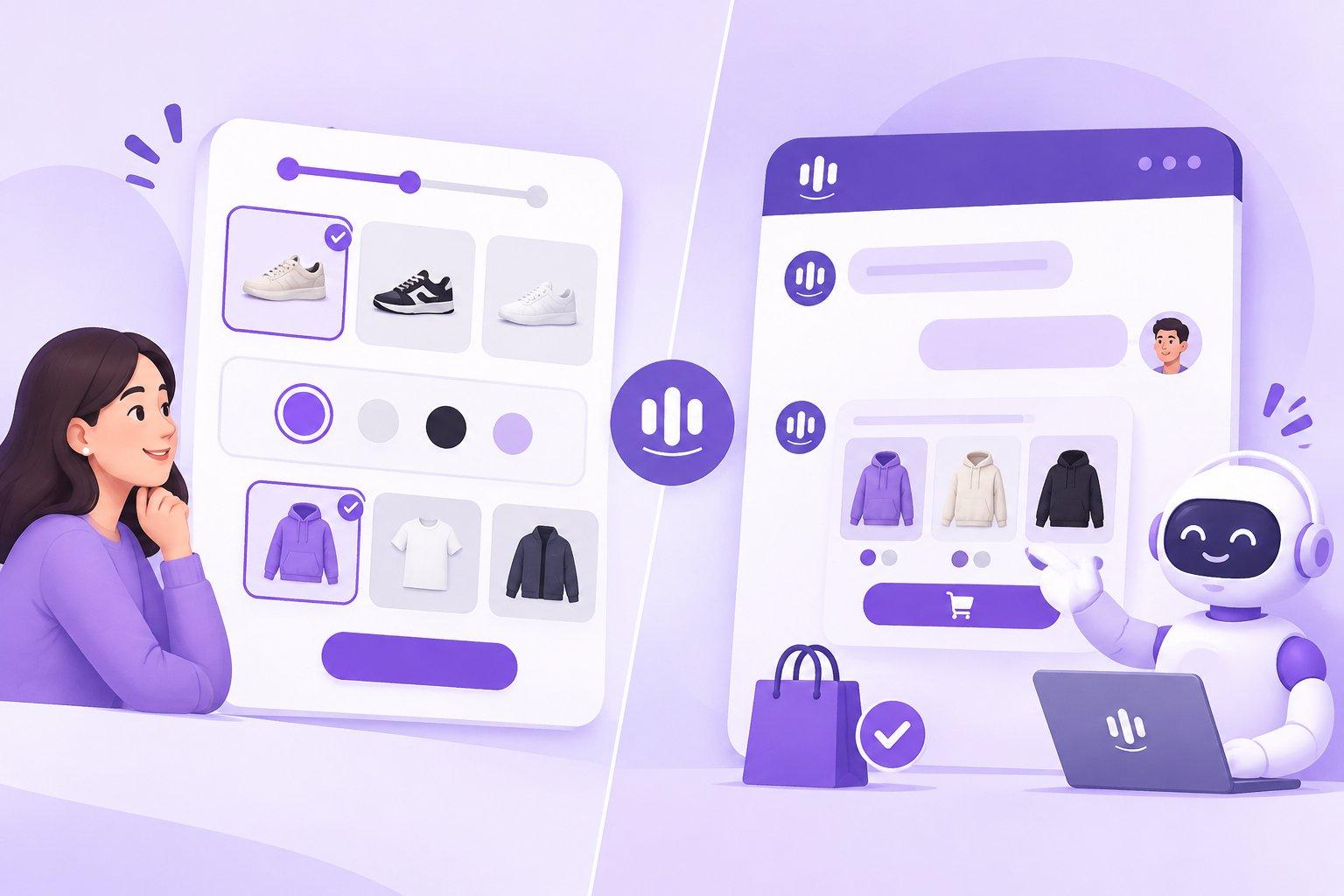
Product Quiz vs AI Shopping Assistant: Which Recommends Better on Shopify?
Short answer: a product quiz works best when your catalog fits a clear decision tree (skin type, coffee strength, dog size) and shoppers are happy to click through a few fixed questions. An AI shopping assistant works best when shoppers have specific, varied questions, want to ask follow-ups, or arrive with context that doesn't fit predefined answers. Many Shopify stores benefit from both: a quiz as a structured entry point, and a conversational assistant to handle everything the quiz can't.
Here's how to compare them and decide.
What each one actually does
Product quiz
A product quiz asks a fixed sequence of questions, usually multiple choice, and maps the answers to a product or a short list of products. Example: "What's your hair type? How often do you wash it? Any concerns?" → recommended shampoo and conditioner.
Strengths:
- Predictable and easy to control
- Fun and engaging when well designed
- Good for collecting structured preferences
- Works well for catalogs with clear segments
Limitations:
- Only answers the questions you planned
- Can't handle follow-ups ("Is this one safe for color-treated hair?")
- Requires manual updates when products change
- Some shoppers drop off if the quiz feels long
AI shopping assistant
An AI shopping assistant is a conversational agent that answers questions in natural language and recommends products based on what the shopper says, using your catalog and policies as its knowledge.
Strengths:
- Handles open-ended and unexpected questions
- Supports follow-ups and comparisons ("What's the difference between these two?")
- Can combine recommendations with shipping, sizing, stock and return questions in one conversation
- Available on multiple channels, not just one page
Limitations:
- Needs accurate, well-structured product and policy information
- Needs guardrails and a clear handoff path to humans
- Requires an initial review period to confirm answer quality
Side-by-side comparison
| Factor | Product quiz | AI shopping assistant |
|---|---|---|
| Best for | Clear decision trees | Varied, open-ended questions |
| Follow-up questions | Not supported | Supported |
| Setup effort | Design questions and logic | Prepare product and policy knowledge |
| Maintenance | Update logic when catalog changes | Keep catalog and policies up to date |
| Channels | Usually one page on your store | Store chat and messaging channels |
| Handles shipping/returns questions | No | Yes, if documented |
| Collects structured data | Yes | Yes, through conversation |
| Shopper effort | Click through fixed steps | Type or ask naturally |
When a product quiz is the better choice
Choose a quiz first if:
- Your catalog has a small number of clear segments
- Shoppers often don't know what to ask, and benefit from being guided
- You want a branded, interactive experience for campaigns or landing pages
- You need consistent, structured data for segmentation
Example: a coffee subscription store with a handful of roast profiles. A five-question quiz about taste preferences and brewing method can match most shoppers to the right roast.
When an AI shopping assistant is the better choice
Choose a conversational assistant first if:
- Your catalog is large or highly varied
- Shoppers arrive with specific questions ("Do you have a waterproof version under $100?")
- Purchases involve compatibility, sizing or usage questions
- Shoppers message you on Instagram, Messenger, WhatsApp or email, not just your website
- You want recommendations and support (orders, shipping, returns) in the same place
Example: an outdoor gear store with hundreds of products. Shoppers ask about weight, weather, sizing and delivery dates, often in the same conversation. A fixed quiz would miss most of that.
Why combining them often works best
A quiz and an assistant are not competitors. A practical combined setup:
- Quiz as an entry point on your homepage or a campaign landing page
- Assistant available on every page, including the quiz results page
- When a shopper sees quiz results and asks "What about this one instead?", the assistant picks up the conversation
- Questions that come up repeatedly in chat feed back into improving the quiz
This way, the quiz guides undecided shoppers, while the assistant handles the long tail of questions.
How to evaluate recommendations, whichever you choose
Don't judge by how impressive the tool looks. Judge by outcomes:
- Relevance: would a knowledgeable sales associate have recommended the same product?
- Accuracy: are prices, variants, stock and policies correct?
- Completion: how many shoppers finish the quiz or conversation?
- Conversion: how many recommendation sessions lead to an order, compared to a baseline?
- Escalations: how often does the shopper need a human, and why?
Review transcripts or quiz results regularly. They reveal gaps in your product information and in your store's navigation.
Setting up an AI shopping assistant responsibly
If you go conversational, a few rules keep quality high:
- Answer only from your own data: catalog, policies, documents
- Hand off when unsure, with a summary for your team
- Start in draft mode, where the AI suggests replies for review before sending
- Write a short brand voice guide so recommendations sound like your store
- Keep product data current, especially stock and pricing
How TaggoAI helps
TaggoAI for Shopify gives your store a conversational assistant that recommends and supports:
- Product recommendations in chat, based on your own catalog
- 24/7 coverage on store chat, Messenger, Instagram, WhatsApp and email
- Order lookup, delivery tracking and abandoned cart recovery in the same assistant
- Answers from your data only, with handoff to a human plus a conversation summary when it isn't sure
- Four autonomy levels, from suggestion-only to acting within limits you set
The 14-day trial starts with a week where the AI drafts answers without sending them, so you can judge recommendation quality on real questions before going live.
FAQ
Can an AI assistant replace my product quiz? For some stores, yes. For others, a quiz remains a great guided entry point. Test both and compare conversion against your baseline.
Do I need perfect product data for an AI assistant? Not perfect, but accurate and reasonably complete. Missing details lead to more handoffs; incorrect details lead to wrong answers.
Which is faster to launch? A simple quiz can be quick if your catalog is small. An AI assistant can be quick too when it learns from your existing store content, but plan a review period.
Will shoppers trust AI recommendations? Trust comes from accuracy and honesty. An assistant that admits uncertainty and brings in a human builds more trust than one that guesses.
Conclusion
Product quizzes excel at guiding undecided shoppers through clear choices. AI shopping assistants excel at real conversations: follow-ups, comparisons, and the shipping and sizing questions that decide a purchase. Many stores get the best results by combining the two.
👉 Curious how a conversational assistant would recommend from your catalog? Try TaggoAI for Shopify free for 14 days at taggoai.com.
Sẵn sàng nâng tầm chăm sóc khách hàng?
Tạo AI Agent thông minh cho doanh nghiệp của bạn chỉ trong vài phút.

