AI Agents vs Chatbots: What's the Difference and Which Does Your Business Need?
Unpack the fundamental differences between legacy rule-based chatbots and autonomous AI agents in 2026. Understand reasoning engines, multi-step tool execution, and long-term customer memory to decide which architecture fits your business scale.
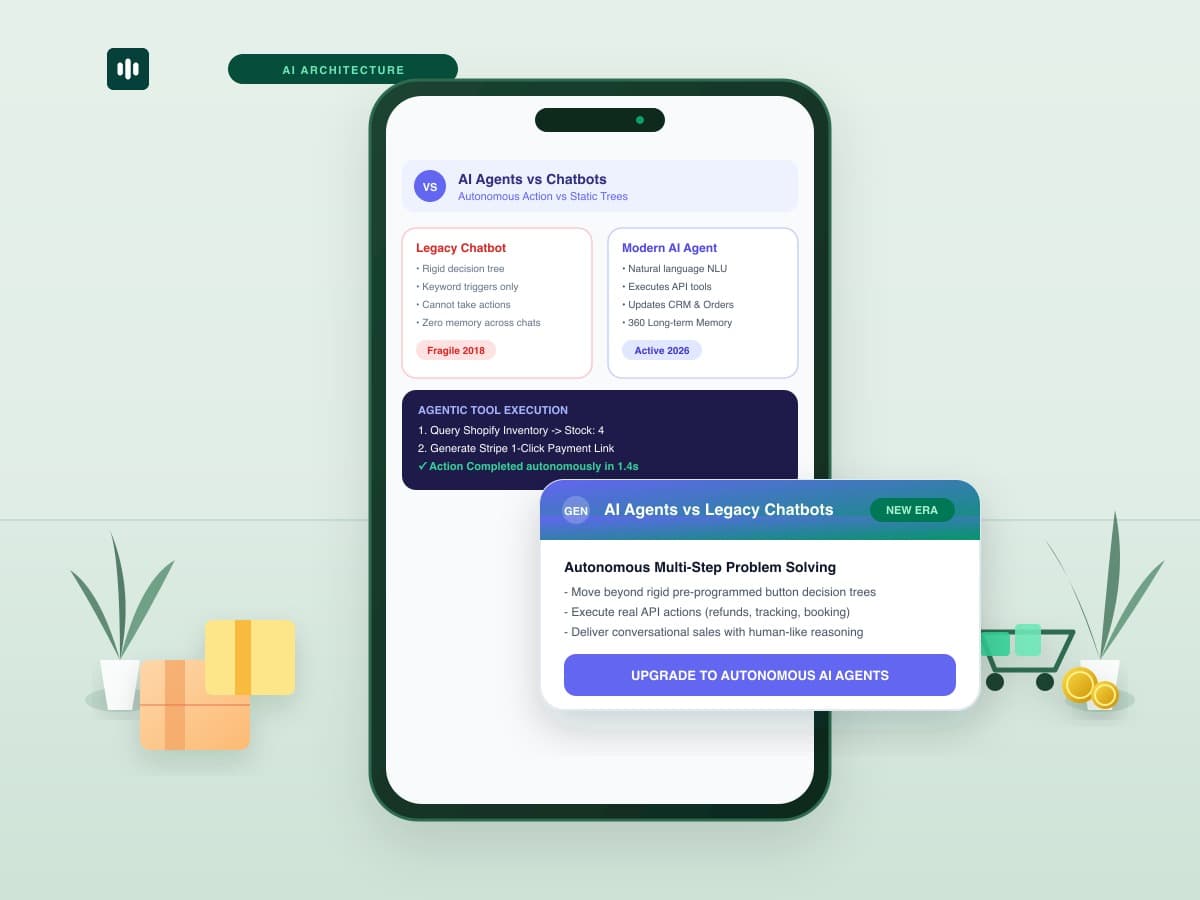
The Core Distinction: While traditional chatbots are rigid, rule-following scripts that trigger pre-written text based on keywords or button clicks, AI Agents possess reasoning capabilities, understand complex human context, execute multi-step software tools autonomously, and remember long-term customer history to solve end-to-end business problems.
Over the past decade, almost every business has experimented with chatbots. Yet, for millions of consumers, the word "chatbot" still triggers memories of frustrating loops: clicking through infinite menu buttons, typing a natural question only to receive "Sorry, I did not understand your request", and frantically typing "AGENT!" to reach a human.
In 2026, the rise of Autonomous AI Agents has rendered legacy chatbots obsolete. This guide breaks down the architectural differences, business implications, and how to determine which solution aligns with your growth goals.
1. Architectural Breakdown: How AI Agents Differ from Chatbots
Deterministic Tree Architecture
- Logic: Follows hardcoded IF/THEN decision branches.
- Language Processing: Exact keyword matching; breaks on typos, slang, or nuanced questions.
- Action Capability: Cannot execute actions outside static webhook calls.
- Memory: Resets completely after every session.
Cognitive Reasoning & Tool Execution
- Logic: Dynamic multi-step reasoning (ReAct framework).
- Language Processing: Natural language understanding (NLU) across 50+ languages and colloquialisms.
- Action Capability: Interacts with live APIs to issue refunds, update CRM records, and generate custom payment links.
- Memory: 360-degree persistent customer memory across all messaging channels.
2. Real-World Scenario Comparison
| Customer Query | Legacy Chatbot Response | TaggoAI Agent Action |
|---|---|---|
| "I ordered the green blazer last week but it's too tight around the shoulders. Can I swap it for size L?" | "Please select an option from below: 1. Track Order 2. Return Policy 3. Speak to Agent" |
1. Identifies Order #4819 for Green Linen Blazer. 2. Checks warehouse inventory for Size L (Stock: 5 available). 3. Generates prepaid return label and reserves Size L in 1.4s. |
| "Can you recommend a skincare routine for sensitive dry skin under $80?" | "Here is our Skincare catalog link: website.com/skincare" | Curates a 3-step bundle (Cleanser + Hydra B5 Serum + Ceramide Cream) totalling $74, explains hypoallergenic benefits, and attaches a 1-click cart. |
3. Decision Framework: Which Solution Does Your Business Need?
Choose a Simple Chatbot If:
You only need to display static business hours, provide link buttons to external help docs, and process fewer than 50 queries per month without any CRM or inventory integrations.
Choose an AI Agent (TaggoAI) If:
You run an e-commerce or omnichannel business, manage thousands of multi-channel conversations, require real-time stock/order integrations, and want support conversations to generate measurable sales revenue.
Upgrade from Rigid Chatbots to Autonomous AI Agents
Empower your brand with an AI Agent that reasons, acts, and drives revenue 24/7.
Build Your AI Agent NowReady to elevate your customer experience?
Deploy intelligent AI agents for your business in minutes.